CERAMIC SCULPTURE DECORATION
Updated: Feb 2, 2024

When I started sculpting, I thought that the most complicated thing would be to learn anatomy and techniques to improve my sculptures, and it is true, I spent many hours practising and improving my technique. But with time I got better and better and I got what I wanted, what I didn't imagine was that the most difficult thing would be to find the finish that I like, the finish that works well with my work, that identifies me and that is only mine.
in the beginning, I thought about leaving the sculptures white, without doing anything to them, but something inside me told me that I had to try to give them life, to give them colour, but I was afraid to paint the sculptures and ruin my work, which has happened to me more than once trying different techniques to finish my pieces.
I do ceramic sculpture, my sculptures are fired in a kiln, so the techniques I have to use must be focused on ceramic sculpture.
There are many techniques, to decorate a sculpture. I will talk about the ones I have tried for my sculptures.
GLAZES

Ceramic glaze or ceramic glaze is a fluxing inorganic coating that is fixed on ceramics at high temperatures (800 to 1250 °C). It is a vitreous-based substance and can be of any colour type.
Glazes give a vitrified layer to the ceramic. I usually use transparent glaze which allows me to use China painting to paint over glaze. The china painting should be fired at 750 - 800 C so that it will set in the glaze. then you can paint over the glaze.
The problem with glazing is that you lose the details of the sculpture when you glaze and if you make a mistake it is difficult to fix.
UNDERGLAZES

Underglazes are high-clay slurries that are applied to leather hard or dry ceramics and fire opaque. If desired, it can be covered with a transparent glaze to give it a glossy shine.
They are used for functional or decorative purposes. They do not alter the sculpture, meaning that they do not eat into the details. The colour is better controlled than with glazes, they give more precise colours and also serve to soften the sculpture, using them in thin layers. They do not give surprises like glazes.
OXIDES

Traditionally the most commonly used are iron, copper, cobalt, manganese and rutile. In this technique, carbonates can be applied (which gives less strength), or pigments, with more uniform results, are generally grouped under the heading of decoration with oxides.
Iron oxide gives reddish and brownish tones.
Copper oxide gives greens and turquoise.
Cobalt oxide gives blues.
Nickel gives greens, blues and browns.
Manganese gives dark brown and violet colours.
Their finish is intense and interesting colours but they do not work for what I want.
TERRA SIGILLATA
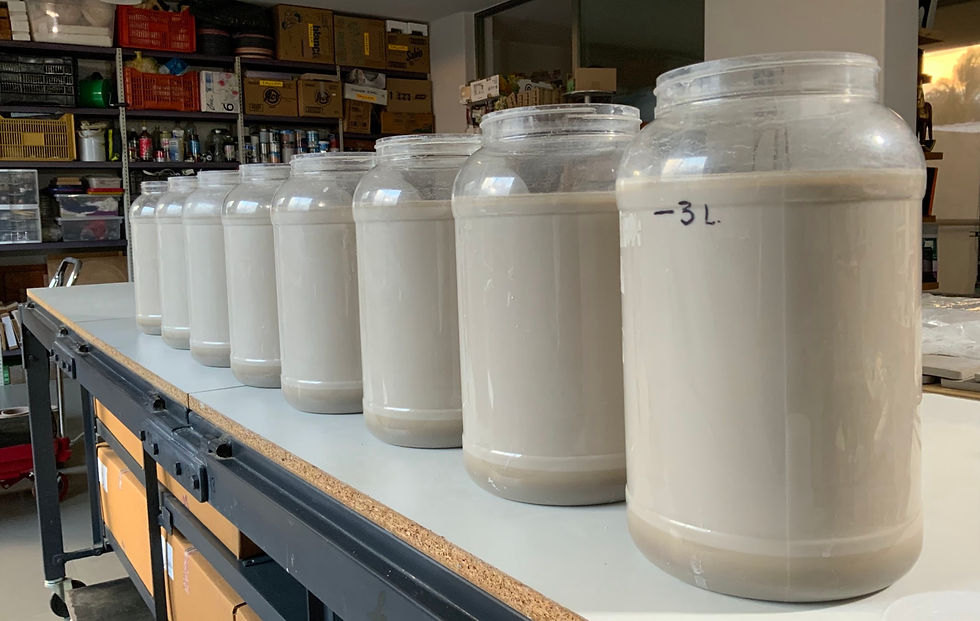
Terra sigillata is an ultrarefined clay slip that can give a soft sheen when applied to bone-dry wares and, if polished or burnished while still damp, may give a high gloss. The ancient Greeks and Romans used this technique in lieu of glaze.
It gives a delicate and uniform finish, it softens the piece and you can use pigments and oxides to give it colour. Depending on the clay you use, the colour of the terra sigillata will change. It gives a very nice finish.
MILK PAINT

Milk Paint is an antique paint containing milk protein (casein), limestone, clay and natural pigments. Milk Paint provides a fully breathable coating and is ideal for painting wood, plaster, drywall and other porous surfaces.
Milk paint works very well on fired clay, they give a very organic and natural matt colour. It can be used as a velatura and that helps you control the colour and finish. It is bought in powder and is prepared by mixing the pigment with water.
CHALK PAINT

Chalk Paint is a natural paint made from calcium carbonate, it is a water-based paint with a matt finish similar to the appearance of chalk.
It is similar to milk paint, only more opaque and thicker. It is available as a spray, easier to obtain than milk paint.
OIL PAINT

The technique of oil painting consists of mixing different pigments with an oil-based binder, usually of vegetable origin. Due to its consistency, oil painting allows you to create a wide palette of colours.
Oil paint is easy to obtain and has a wide variety of colours, but you have to know the technique to get a natural finish. One problem with oil paint is the drying time, it takes a long time to dry, and you have to be patient to get good results. Working in layers and with velaturas is the best option.
ENCAUSTIC WAX

Encaustic is simply paint made from a combination of white purified beeswax, natural damar tree sap resin, and pigment powder. It is kept molten on a heated palette applied to a surface and reheated to fuse the paint into a uniform enamel-like finish.
They are very covering, although they can be used in velatura if you use little pigment and more base wax. with a heat gun, you can control the wax and paint with it on the sculpture. very interesting finishes.
SOFT PASTEL

Soft pastels are pure pigments, water, and a small amount of artificial binder that holds the pigment together.
I like to use them because they give a very fine and delicate finish, they look very natural. especially for face painting. They are easy to use and easy to apply. I usually paint on a piece of paper and then pass the painter to get the necessary amount of pigment.
WAXES
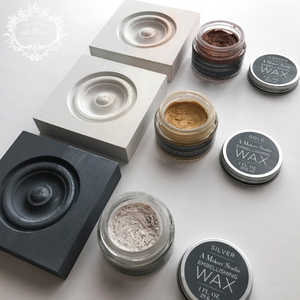
I usually use waxes that have a high pigment content, they are very covering and give a beautiful finish, I usually use them for small details, or to highlight some part of the sculpture. the colours that I use the most are gold, silver and copper.
PATINAS

Patinas for ceramics are special paints that give different effects, imitating the patinas used in bronze sculptures. Some contain metal flakes that react with a reagent to create a patina effect. It's a bronze or copper metal paint with metal flakes that react to a patina.
Among the best brands are Modern Masters and Sculpt Nouveau
Acrylics

Acrylic paint is a quick-drying paint where the basis of its pigmentation is formed by an acrylic polymer emulsion. This component is a derivative of latex, in charge of providing hardness and resistance to the paint once dry.
Great variety of colours and possibilities, before applying on the ceramic a primer must be applied so that the acrylic paint is fixed to the ceramic. It can be applied with an airbrush and the finish is beautiful and easy to use as it dissolves in water.
I prefer to use natural and organic products to decorate my sculptures, so I avoid painting with acrylics.
There are many products on the market to use, these are the ones I have tried, some results I have liked and some I haven't, but to find the finish I like I just have to test and discard.
It's important to use quality products, as it shows in the finish. You do not necessarily have to buy the most expensive brands, but if you buy a mid-range, it will show in the quality and finish.


Beautiful